
Search Orleans Parish Family History
Orleans Parish genealogy records are among the most extensive in North America, with the Notarial Archives Research Center holding over 35 million pages of documents from 1731 to the present, and Civil District Court records including marriage documents from 1718, meaning New Orleans researchers have access to French colonial, Spanish, and American-era primary sources spanning three centuries of Louisiana family history. This guide covers how to search, request, and access those records through the civil clerk, criminal clerk, and the Notarial Archives.
Orleans Parish Quick Facts
Orleans Parish Clerk of Court
Orleans Parish has two separate court clerk offices: the Civil District Court Clerk and the Criminal District Court Clerk. For genealogy research, the Civil District Court is the primary resource. Hon. Chelsey Richard Napoleon serves as Clerk of Civil District Court. The Notarial Archives Research Center, located at the Poydras Street office, is the specialized facility for historical records research.
| Civil District Court (Clerk) | Hon. Chelsey Richard Napoleon |
|---|---|
| Civil Office Address | 1340 Poydras St., Suite 360, New Orleans, LA 70112 |
| Civil Mailing Address | 421 Loyola Ave., Room 402, New Orleans, LA 70112-1198 |
| Civil Phone | (504) 407-0106 |
| Civil Fax | (504) 407-0208 |
| Civil Email | cdcclerk@orleanscdc.com |
| Civil Website | orleanscivilclerk.com |
| Civil Hours | Monday-Friday, 8:30 AM - 5:00 PM |
| Criminal Court Clerk | Hon. Darren Lombard |
| Criminal Address | 2700 Tulane Ave., Room 114, New Orleans, LA 70119 |
| Criminal Phone | (504) 658-9000 |
| Criminal Website | criminalcourt.org |
| Research Center Email | civilclerkresearchctr@orleanscdc.com |
The Notarial Archives Research Center at 1340 Poydras St. is open to the public for self-service research Monday through Friday, 8:30 AM to 5:00 PM. Staff at the research center are experienced with the colonial records and can assist with French and Spanish-language documents. Professional research services are available for a fee by contacting civilclerkresearchctr@orleanscdc.com. In-person self-service is free; copies and certified documents have per-page and per-document fees.
The Orleans Civil Clerk website provides direct access to civil records search, the Notarial Archives research portal, and department information.
Go to orleanscivilclerk.com to access the civil records search and the Notarial Archives Research Center information for Orleans Parish.
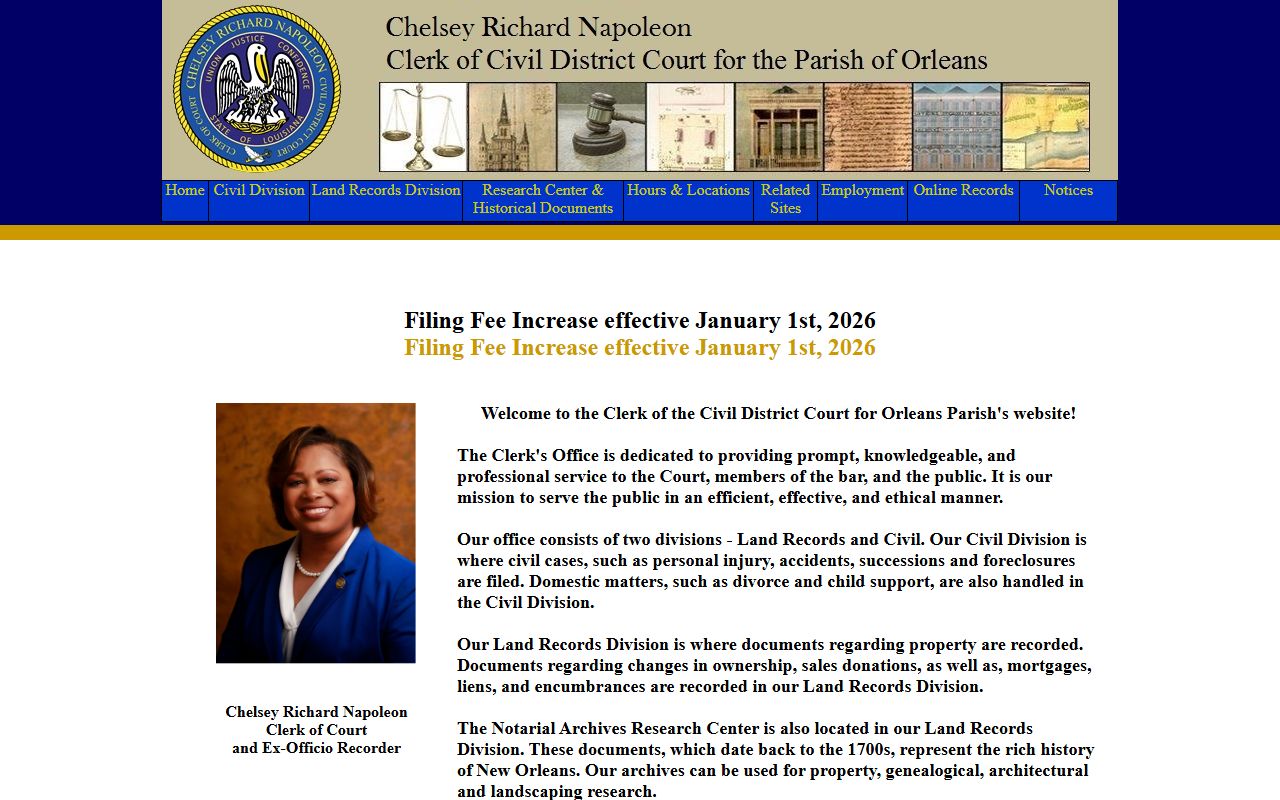
The Orleans Civil Clerk site provides free index search for many records and links to the Notarial Archives Research Center, which houses over 35 million pages of historical documents.
Search Orleans Parish Genealogy Records Online
The Orleans Civil Clerk website provides a free index search for civil records. You can search by party name to locate case information, then request copies for a fee. The Notarial Archives at 1340 Poydras St., Suite 360, holds over 35 million pages of records from 1731 onward and is the single most important facility for Orleans Parish genealogy research. These records cannot be fully searched online; in-person visits or correspondence with the research center are required for detailed archival work.
The LA Clerks Portal at laclerksportal.org offers an additional online access point. Create a free account to access records through this statewide portal. Some Orleans Parish records are accessible through this system. It is worth creating an account to determine what is available before planning a visit.
For vital records, the Louisiana Online Public Vital Records Index covers Orleans Parish birth and death records that fall outside the confidentiality window under RS 40:41. This free index is the starting point for vital records research. The Louisiana Vital Records Registry, which is physically located in New Orleans at 1450 Poydras Street, Suite 700, issues certified copies of birth and death records.
Note: Orleans Parish has a unique structure because it functions as both a city and a parish. The Civil District Court handles civil matters including marriages, successions, and property. The Criminal District Court is a separate entity at Tulane Avenue. Vital records are handled at the state level, not by either clerk. Researchers often need to contact all three offices depending on the type of record they seek.
Genealogy Records in Orleans Parish
Orleans Parish holds records from three distinct governmental periods. The French period (1718-1769) includes the earliest New Orleans records. The Spanish period (1769-1803) added a new layer of documentation. The American period began with the Louisiana Purchase in 1803. Each period created records in different languages and formats, which is part of what makes Orleans Parish research both challenging and rewarding.
Key record types and their starting dates at the Orleans Civil District Court and Notarial Archives:
- Notarial Archives: 1731 to present (over 35 million pages)
- Marriage records: 1718 to present
- Divorce records: 1805 to present
- Probate and succession records: 1805 to present
- Conveyance records with party-name indexes: 1827 to present
- Family Records Index: 1770-1840 (compiled by Charles R. Maduell, Jr.)
- Building Contract Index: 1767-1970
- Corporate Charter Index: 1852-1904
- Court of Probates records: 1804-1846 (indexed)
Birth certificates cost $15.00 for the first copy and $15.00 for each additional copy. Death certificates are $7.00. Contact the Vital Records Registry at (504) 593-5100. Certified copies can be ordered through VitalChek.
Louisiana State Archives and Orleans Parish
The Louisiana State Archives at 3851 Essen Lane in Baton Rouge holds statewide collections that complement Orleans Parish records. For Orleans Parish specifically, the Archives is most useful for statewide vital records that fall outside the window covered by the Notarial Archives or Civil District Court, and for records from state agencies that operated out of New Orleans.
The online vital records index maintained by the Secretary of State draws on Orleans Parish birth and death records and is a practical first step before requesting a certified copy. Because New Orleans was the site of statewide vital records registration, the Orleans Parish records in the index tend to be among the most complete in Louisiana.
For pre-1803 research, a number of Louisiana colonial records have been published or microfilmed by university archives, the Historic New Orleans Collection, and other institutions. The Historic New Orleans Collection at 533 Royal Street in the French Quarter maintains an extensive research library with New Orleans-specific genealogical materials and is open to the public.
How to Request Orleans Parish Records
In-person research at the Notarial Archives Research Center (1340 Poydras St., Suite 360) is the best approach for historical documents. No appointment is needed for self-service research during business hours. Staff can assist with locating records and explaining the organization of the notarial archive by notary and date. For complex historical research projects, contact civilclerkresearchctr@orleanscdc.com to discuss professional research assistance options and fees.
For civil records including modern marriage and succession filings, the civil clerk's index at orleanscivilclerk.com is the starting point. Search the free index online, then request certified copies by contacting the clerk's office at (504) 407-0106 or by visiting in person at 1340 Poydras St., Suite 360. Mail requests should go to 421 Loyola Ave., Room 402, New Orleans, LA 70112-1198 with specific document citations and prepayment.
For vital records (birth and death certificates), contact the Louisiana Vital Records Registry at 1450 Poydras Street, Suite 700, New Orleans, LA 70112, or call (504) 593-5100. Certified copies can be ordered through VitalChek online. The Louisiana Vital Records office is the sole issuer of certified birth and death certificates in Louisiana. It does not work through the clerk's office.
Criminal records from the Criminal District Court at 2700 Tulane Ave. are handled separately by that clerk's office. Contact (504) 658-9000 for criminal record inquiries. The criminal court's records are generally not used for genealogy research but may be relevant in specific circumstances.
What Orleans Parish Records Contain
The Notarial Archives are the defining feature of Orleans Parish genealogy research. This collection includes property transfers, slave sales and emancipations, marriage contracts, estate inventories, successions (probate records), building contracts, and maps and plats. Pre-1803 documents are in French or Spanish. Post-1803 documents are mainly in English, though French-language notarial practice continued well into the 19th century for many families. The archives are organized by notary and then by date, with annual indexes maintained by each notary.
Marriage records from 1718 onward name both parties, the date and location of the ceremony, and often include parents and witnesses. Divorce records from 1805 document the termination of marriages. Succession records from 1805 are particularly rich for genealogy because they name heirs and their relationships, itemize estate assets, and often include testimony from family members. The Court of Probates records from 1804 to 1846 have an available index and were later handled by district courts.
Conveyance records from 1827 have party-name indexes, making it possible to search for property transfers without knowing the notary. The Family Records Index for 1770 to 1840 is a compiled genealogical resource that draws on multiple record types and is a standard reference for New Orleans family history research. Building contract indexes from 1767 to 1970 can document where families lived and what properties they built or owned.
Birth certificates name the child, both parents, and the place and date of birth. Death certificates name the deceased, the cause of death, the date and place, and the informant, who is usually a close relative. Because New Orleans was Louisiana's registration center, vital records from this parish are generally well-preserved and consistently filed from the period of statewide registration beginning in 1914.
The Notarial Archives Research Center screenshot below shows the facility that holds over 35 million pages of Orleans Parish historical documents.
Visit the Notarial Archives Research Center page to learn about holdings, hours, and how to plan your research visit.
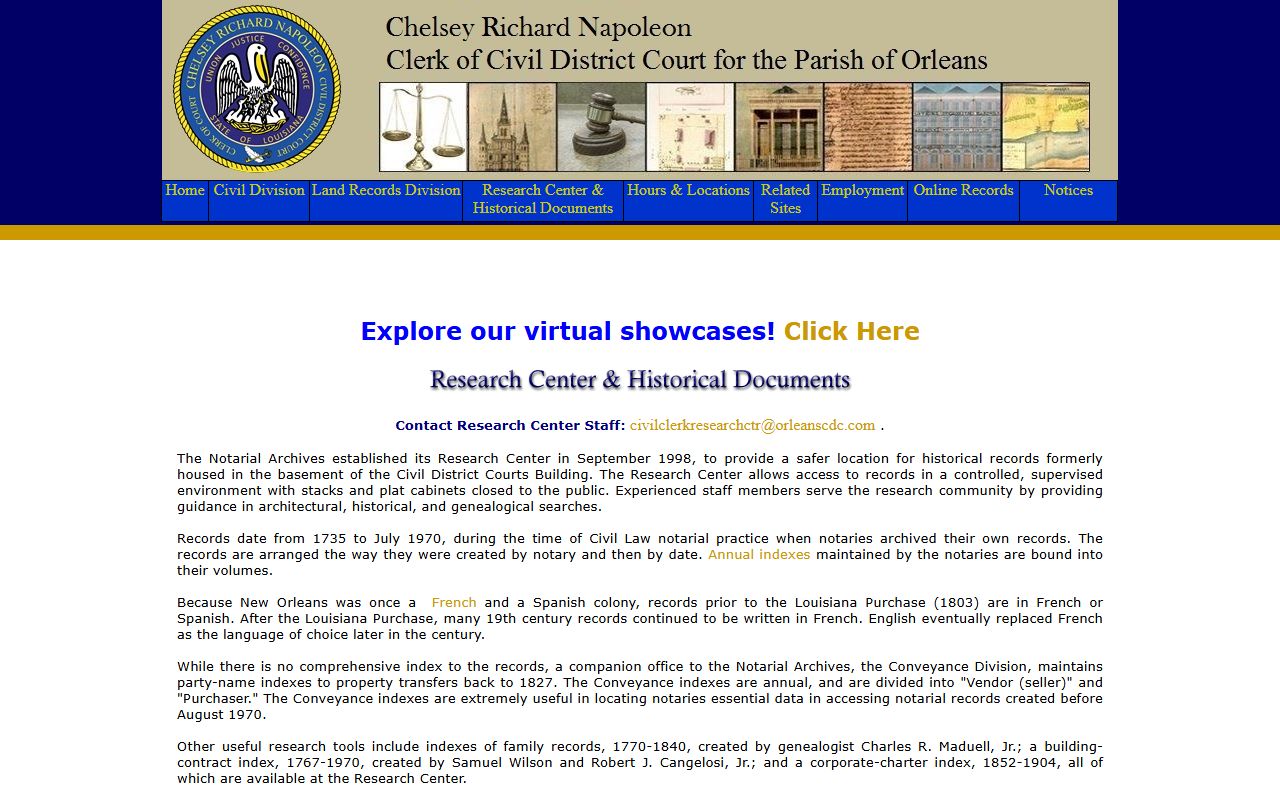
The Notarial Archives at 1340 Poydras St. houses over 35 million pages from 1731 to the present, organized by notary and date, with staff experienced in French, Spanish, and English-language colonial documents.
Cities in Orleans Parish
Orleans Parish and New Orleans are coextensive; the city and parish share the same boundaries. New Orleans is the city for this directory. Other communities within the city include Lakeview, Gentilly, Mid-City, Algiers, and other recognized neighborhoods, but all are part of the same jurisdictional unit served by the Civil District Court and Criminal District Court clerk offices.
Nearby Parishes
Orleans Parish is bordered by Jefferson Parish to the west, St. Bernard Parish to the east, St. Tammany Parish across Lake Pontchartrain to the north, and Plaquemines Parish to the south. Families from New Orleans often had property or relatives in Jefferson and St. Bernard parishes, and Notarial Archives records frequently reference transactions in neighboring jurisdictions.